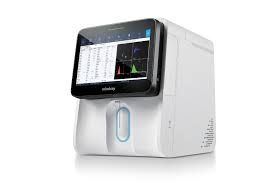
Common features of the BC-700 and BC-720
- Integrated CBC and ESR: Both models perform both CBC and ESR tests from a single blood tube in just 90 seconds, significantly streamlining lab workflow, saving time, and improving safety.
- SF Cube technology: The analyzers use the advanced "SF Cube" 3D analysis technology, which relies on light scatter and fluorescence to analyze cell size, granularity, and nucleic acid content. This provides a more comprehensive and accurate analysis of blood components.
- Advanced flagging and analysis: The BC-700 series provides advanced flagging for abnormal cells and can distinguish immature granulocytes (IG) and nucleated red blood cells (NRBCs). It also addresses interference issues with platelets, ensuring accurate results.
- PLT-H parameter: Both models include a new parameter, PLT-H, which combines impedance and optical methods for measuring platelets. This helps to overcome common interferences from small red blood cells or large platelets, resulting in more reliable platelet counts.
- Westergren-correlated ESR: The built-in ESR functionality provides results that are highly correlated with the traditional Westergren method but with better quality control, speed, and safety due to the automation.
- User-friendly design: The analyzers feature an intuitive design and a small footprint, making them well-suited for labs with limited bench space.
Differences between the BC-700 and BC-720
The main difference between the two models is their mode of sample handling. They are both classified as open-vial models, meaning samples are manually loaded. However, they are part of a larger series that includes automated versions.
- BC-700: An open-vial model designed for manual sample loading.
- BC-720: An open-vial model with a 6-part differential, also requiring manual loading.
For a higher throughput solution, Mindray also offers the autoloader models, BC-760 and BC-780, within the same series.